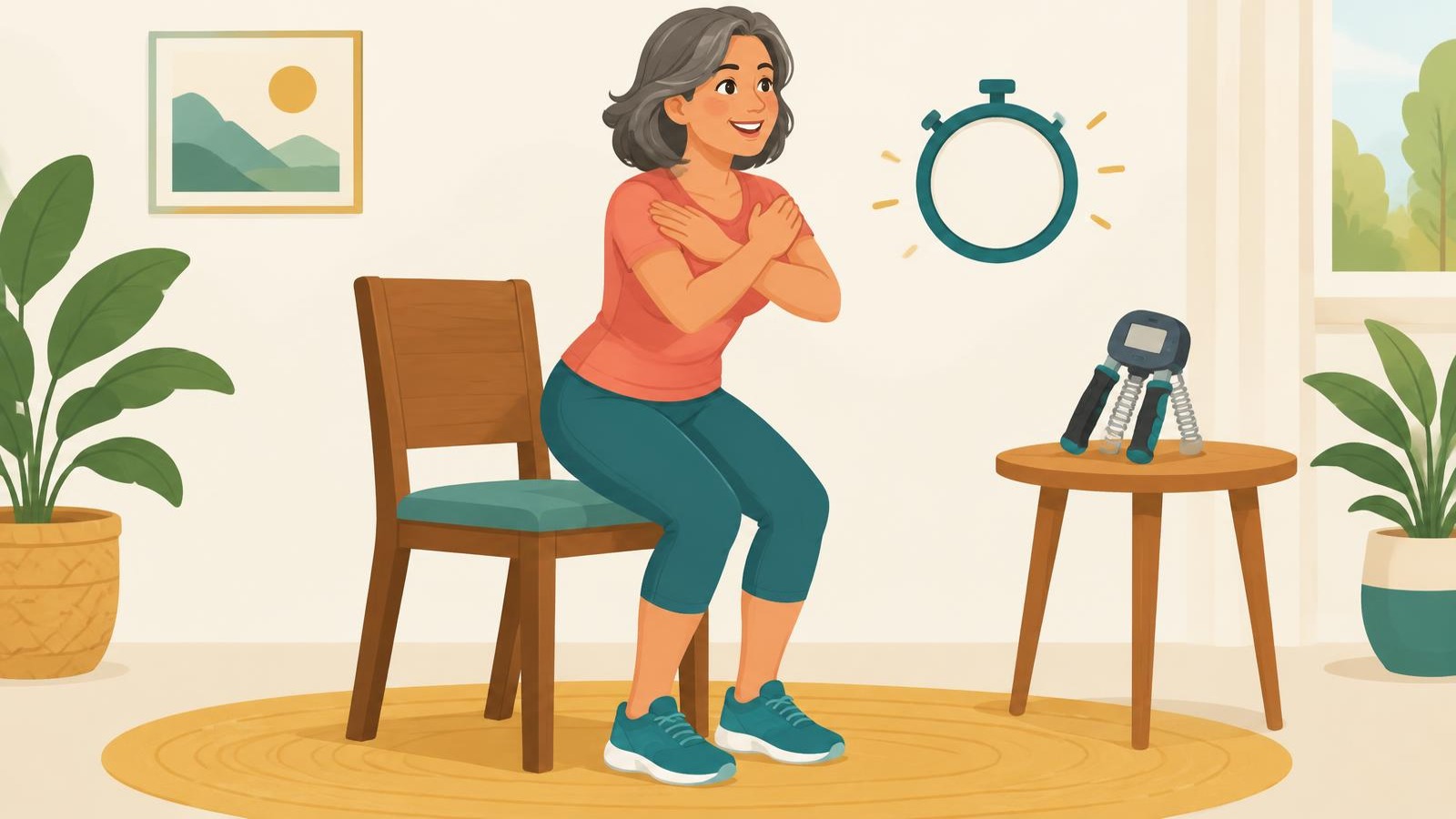
A 2026 study in JAMA Network Open followed 5,472 women aged 63 to 99 for an average of 8.4 years and tested two things you can measure in under two minutes: how hard they could squeeze a hand grip device and how fast they could stand up from a chair five times. Women in the strongest quarter of each test had about 30% lower risk of dying during follow-up than weaker women, and that held up after the researchers accounted for how much the women moved, how much they sat, and their overall fitness. The women were far older than most people reading this, and the study shows association, not cause. Still, it gives you a useful message for midlife: strength is something you can measure, track, and build now, long before it becomes a question of whether you can get out of a chair.
What did the researchers actually measure?
They used data from the Objective Physical Activity and Cardiovascular Health study, which enrolled 5,472 women who could walk on their own. The average age was 78.7. About half were White, a third were Black, and about 17% were Hispanic or Latina, which makes this a more diverse group than many aging studies. Each woman completed two performance tests: dominant-hand grip strength in kilograms, and the time needed to complete five chair stands without using her arms. The women also wore accelerometers for seven days, so the researchers could account for real, measured activity and sitting time instead of relying on what people remembered. Over an average of 8.4 years of follow-up, 1,964 of the women died.
How big was the difference?
Meaningful, and it did not disappear when the researchers adjusted for the obvious explanations. Compared with the weakest quarter, women in the strongest quarter for grip strength had a hazard ratio of 0.70 after adjusting for physical activity and sedentary time, which means roughly 30% lower risk of death over the follow-up period. The chair-stand result was nearly identical at 0.69. Both associations looked similar across age groups, race and ethnicity, and body mass index. One note on numbers: press coverage of this paper quoted different "per unit" figures for each 7 kilograms of grip strength or each 6 seconds of chair-stand time, and the coverage did not agree with itself. The quartile results from the paper's abstract are the cleaner numbers, so those are the ones used here.
Does stronger mean longer-lived, or do healthy people just have stronger grips?
Both could be partly true, and the honest answer is that this study cannot separate them. It is an observational cohort study. A woman with an undiagnosed illness may grip weakly and also be more likely to die, which would make weakness look like a cause when it is really a warning sign. The researchers did adjust for activity, sedentary time, walking speed, and an inflammation marker called C-reactive protein, and strength still predicted survival, which makes a pure "illness explains everything" story less likely. But adjustment never removes every confounder. Nothing here proves that raising your grip strength by 7 kilograms adds years to your life. What it supports is the narrower claim that strength is a strong marker of resilience, one that carries information beyond how much you move.
Why does this matter if I'm 45 or 55, not 78?
Because the women in this study are what the end of the story looks like, and the starting line is now. Muscle and strength decline with age, and the transition through perimenopause and menopause is a period when many women lose muscle faster and gain fat more easily. We have written before about how fast bone is lost around the menopause transition, and muscle and bone tend to move together. The women in this cohort could not go back and build more reserve at 50. You can. The practical takeaway is not to panic about a number. It is to treat strength as a vital sign you actually measure, the way you measure blood pressure, and to start building it while building is still easy.
Can I test this myself?
You can run a rough version of the chair test at home, and you should not treat the result as a diagnosis. Use a sturdy chair against a wall, sit with your arms crossed over your chest, and time how long it takes to stand up fully and sit back down five times. Write the number down and retest in a few months. Grip strength is harder to check without a dynamometer, but many clinics and gyms have one, and it takes about a minute. Neither number tells you whether you are healthy. What matters is the direction over time: if your chair-stand time is getting slower or your grip is dropping, that is information worth acting on, and a good reason to talk with a clinician.
How much training does it take to build this?
Less than most people assume, and that is the encouraging part. We covered the minimum effective dose of strength training after 40, and the short version is that two or three well-planned sessions a week can produce real strength gains without living in the gym. The harder part is consistency, not complexity. If you struggle to stay with a plan, the research on early habit formation suggests lowering the bar so you clear it every week. A short session you actually do beats an ambitious one you skip. The legs matter most for the chair test, so squat patterns, step-ups, and hip hinges are the movements that carry over. For grip, carries and rows do the job.
How does this fit into what we do at Vitality Dartmouth?
I build the program and coach the training. When someone starts with us, strength and movement tests are part of the baseline, because a number you can retest tells us more than how someone feels on a given day. Our collaborating NP or MD handles anything medical, including labs and any questions about hormone health that sit behind changes in muscle and energy. If your strength or stamina has dropped and you do not know why, that is a conversation worth having with both of us in the room.
Does this look different on the SouthCoast?
The biology is the same everywhere. What differs is how many people get any strength assessment at all. We talk with women across Dartmouth, New Bedford, Westport, Fairhaven, and Fall River who have had cholesterol and blood pressure checked for years but have never been asked to stand up from a chair five times or squeeze a grip device. Those two quick tests are cheap, repeatable, and are some of the best-supported predictors of how people age.
Frequently asked questions
Is grip strength really a good predictor of how long I will live?
In this cohort of older women, yes, it was a strong independent marker. It is still a marker, not a verdict, and it works best as one piece of a larger picture that includes blood pressure, labs, activity, and how you feel.
Do I need to lift heavy to improve grip and leg strength?
Not necessarily. Progressive resistance training, meaning gradually increasing the challenge over time, is what matters. A coach or clinician can help you choose loads that are safe for your joints, bone density, and history.
What if my chair-stand time is slow?
Do not panic. Write the number down, ask your provider whether anything medical could be contributing, and start building. Many people improve noticeably within a few months of consistent leg training.
Does this study apply to women in their 40s and 50s?
Not directly. The participants were mostly in their late 70s, so the results describe older women. The reasonable inference for midlife is that building strength earlier gives you more reserve, but that inference goes beyond what this study tested.
Want your own strength baseline?
If you have never had your strength measured, book a free discovery call. We will set a baseline, build a plan around it, and make sure the right clinician is involved for anything medical.
Sources
Educational disclaimer: This article is general health education and is not medical advice, a diagnosis, or a treatment recommendation for any individual. It does not create a clinician-patient relationship. Vitality Dartmouth is an RN-led clinic; all prescriptions and diagnostic orders are written by a collaborating nurse practitioner or physician. Individual results vary, and no outcome is promised or guaranteed. Talk with your own licensed healthcare provider before beginning or changing an exercise program, especially if you have a medical condition, pain, or a history of falls. Call 911 for a medical emergency.