THE SHORT ANSWER: Continuous glucose monitors, once limited to people with diabetes, are now sold over the counter to anyone curious about their blood sugar. The FDA cleared Dexcom's Stelo as the first over-the-counter CGM for adults in 2024 and later expanded that clearance to children as young as two. The largest real-world dataset on non-diabetic CGM use, a 2026 analysis of 3,634 metabolically healthy adults published in Nature Communications, found that people without diabetes spend the large majority of their day in a tight glucose range and that diet, sleep, and activity all move the needle in measurable ways. What the same research does not yet show is that wearing a CGM without diabetes changes your long-term health outcomes. The device can teach you real things about your body. It has not yet been proven to be something everyone needs.
What a CGM actually measures, and what changed recently
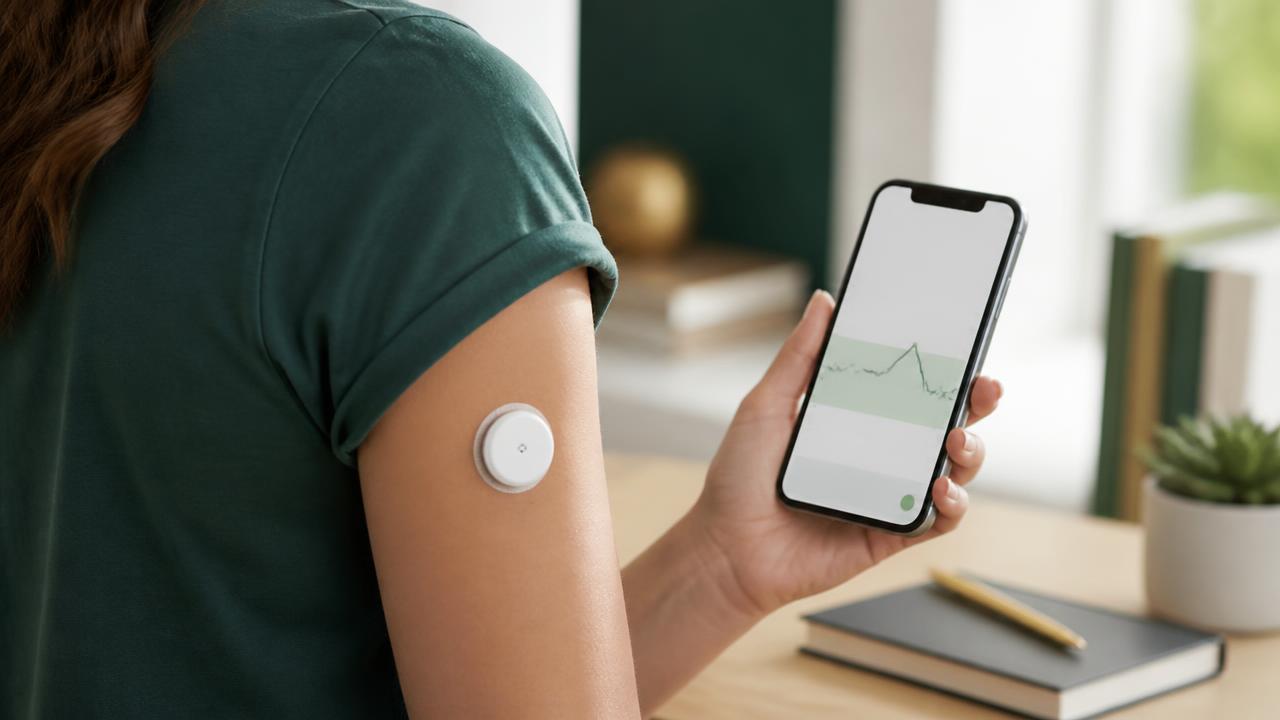
A continuous glucose monitor is a small sensor worn on the arm or abdomen that checks your blood sugar every few minutes through fluid just under your skin, instead of a single finger-stick reading. For years these devices required a prescription and were built for people managing diabetes. That changed when the FDA cleared Stelo as the first over-the-counter CGM, indicated for people two years of age and older who do not use insulin. The clearance covers both people with diabetes managed through oral medication and people without diabetes who want general glucose awareness.
The FDA is specific about one limitation that matters here. Stelo "is not for people with problematic hypoglycemia because it is not designed to alert users" during dangerous low-glucose episodes. It is a wellness and awareness tool, not a medical alarm system, and it is not intended for people on dialysis or with an eating disorder without medical guidance first.
The largest real-world look at glucose in people without diabetes
Most of what gets said about CGMs and non-diabetics online is based on small samples or anecdote. The most useful recent data comes from a 2026 analysis in Nature Communications that pooled three PREDICT cohort studies from the UK and US, covering 3,634 adults without diabetes or prediabetes.
The numbers give a real baseline. The median adult in this healthy population spent about 73% of the day in a tight glucose range of roughly 70 to 101 mg/dL, and about 95% of the day in the broader range of 70 to 140 mg/dL, the same range used as a diabetes management target. Average glycemic variability, a measure of how much glucose swings up and down, came out to a coefficient of variation of about 15%.
The lifestyle associations are where this study earns its keep. Higher carbohydrate intake tracked with more glucose variability. Higher protein intake tracked with more time spent in the tighter range. Longer sleep correlated with lower average glucose. An exploratory tight time-in-range metric showed moderate ability to flag ten-year cardiovascular risk, with an accuracy score the researchers called meaningful but not yet strong enough to act on by itself.
The authors were direct about the limits of their own findings. They wrote that CGM metrics "show potential to capture some components of glycaemic physiology," but that longer-term outcome data is still needed before CGM monitoring can be recommended as a health management tool for people with normal blood sugar. That's an honest, useful sentence, and it's worth reading twice before buying into stronger marketing claims.
Why a glucose spike on your CGM doesn't always mean what you think
One finding from the same research surprises most first-time CGM users. Physical activity showed an association with higher average glucose, not lower, in this non-diabetic population. That sounds backward until you understand the physiology behind it. During intense exercise, your liver and stress hormones release stored glucose to fuel working muscle, which can show up as a temporary rise on a CGM graph. That's a normal, expected response to exertion, not a sign that exercise is bad for your blood sugar.
This is exactly the kind of pattern that trips people up when they start wearing a CGM without any clinical context. A number moving on a graph and a number that means something require different levels of interpretation. Smaller controlled studies comparing CGM readings to standard venous blood draws after meals have found the sensor technology itself tracks closely with lab-accurate measurements, so the data is generally reliable. What varies is how well an untrained reader interprets it.
Where the evidence is genuinely thinner than the marketing suggests
To be direct about the limits here: there is no large, controlled trial showing that healthy, non-diabetic adults who wear a CGM lose more weight, prevent diabetes, or live longer than people who don't. The strongest data so far describes what normal glucose patterns look like and which lifestyle factors move them, which is genuinely useful information. It is not yet proof that the device itself changes outcomes for someone with no metabolic risk factors.
That distinction matters for who actually benefits. Someone with insulin resistance, a family history of type 2 diabetes, PCOS, or an unexplained pattern of energy crashes and cravings is a different case than someone with normal labs who is simply curious. The first group has a clear reason to look closer. The second group may find the data interesting without it changing anything clinically important.
How we use CGM data at Vitality Dartmouth
We don't hand out a CGM as a default add-on for every client. We use it selectively and pair it with context the device alone can't provide.
We check fasting insulin and HOMA-IR first, through the same genomic and lab testing process every client goes through, because insulin resistance often shows up in bloodwork before it shows up as a dramatic glucose swing on a CGM. This is the same insulin resistance screening we've written about here.
We use a CGM as a short-term diagnostic tool for specific questions, not a permanent accessory. A two to four week trial to see how your body actually responds to your current diet and training schedule gives us real information, and then we reassess whether continued use makes sense.
We interpret the graph for you instead of leaving you to guess. A glucose rise after a hard training session at CrossFit Dartmouth means something different than the same rise after a bowl of cereal, and we walk clients through that distinction directly rather than letting an app's generic alert do the interpreting.
We fold CGM findings into your full plan, alongside labs, body composition, and training load, through our coaching programs, rather than treating a single day's glucose graph as a verdict on your metabolic health.
Frequently asked questions
Do I need a prescription for a CGM if I don't have diabetes?
Not for an over-the-counter device like Stelo, which is cleared for people two and older who don't use insulin. Prescription CGMs still exist and may offer different features, but they aren't required for general glucose awareness.
Will a CGM tell me if I'm prediabetic?
A CGM shows patterns, not a diagnosis. Prediabetes is diagnosed through standard bloodwork like A1C or fasting glucose, not a wearable sensor. A CGM can raise a useful question that sends you toward proper lab testing, but it isn't a replacement for it.
Is it normal for my glucose to spike during exercise?
Yes, for many people. Intense exercise can trigger a temporary glucose rise through normal stress hormone and liver activity. That's different from a spike after a meal, and the research above is a useful reminder not to interpret every rise on a graph the same way.
Do you offer CGM-based coaching near me?
Yes. Vitality Dartmouth is based in Dartmouth, MA, and works with clients across the SouthCoast, including New Bedford, Westport, Fairhaven, and Fall River, with RN-supervised lab testing and CGM interpretation built into your plan.
A continuous glucose monitor without diabetes can teach you something real about how your specific body responds to food, sleep, and training. The current research supports that much clearly. It does not yet support the idea that everyone needs to wear one indefinitely, or that a single spike on a graph is a health crisis. The device is a data source. What you do with the data, and whether you have the clinical context to read it correctly, is the part that actually matters.
This article is for educational purposes only and is not medical advice. Continuous glucose monitor data and its interpretation vary by individual, device, and clinical context, and are not a substitute for standard diagnostic lab testing. Discuss your specific situation and any monitoring decisions with a licensed healthcare provider.