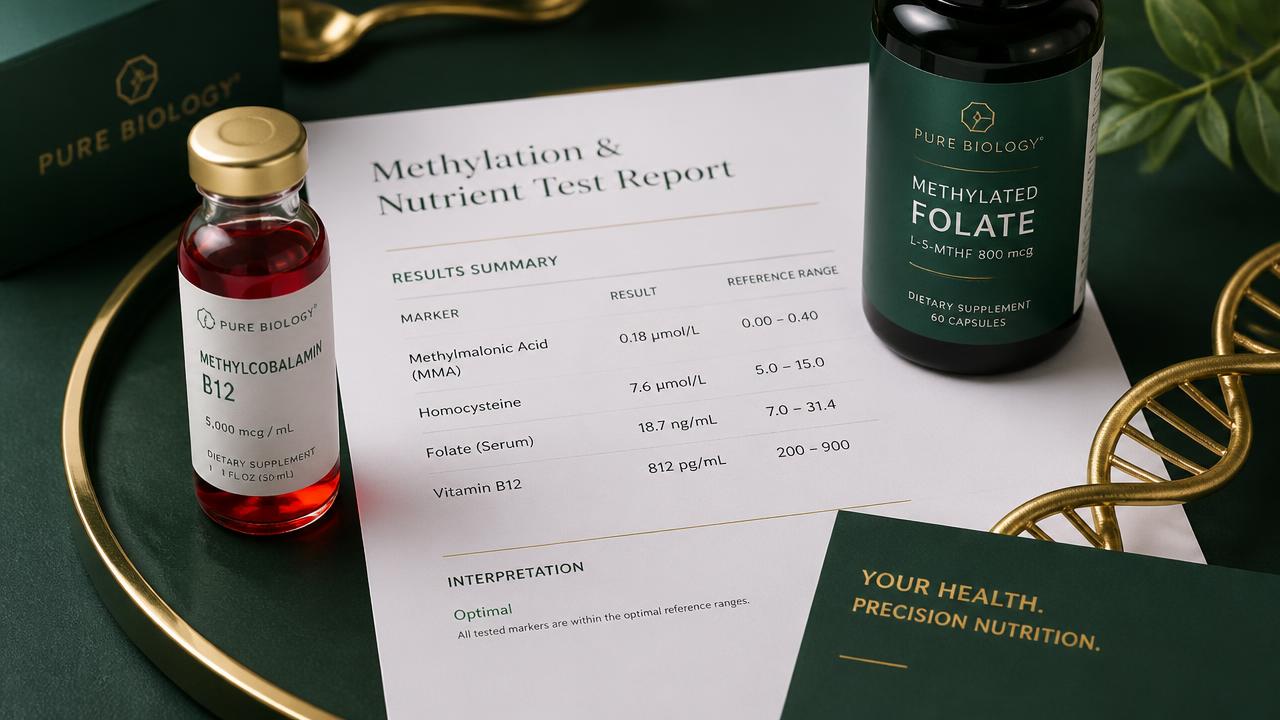
THE SHORT ANSWER: MTHFR genetic testing has become a popular add-on in wellness and functional medicine, but the American College of Medical Genetics and Genomics recommends against routine MTHFR polymorphism testing, calling its clinical utility minimal. Up to half of people carry an MTHFR variant, and most never have a problem from it. What actually predicts real issues is your homocysteine level, not your genotype. Meanwhile, actual vitamin B12 deficiency is common, underdiagnosed, and easy to miss, especially in people on metformin or a proton pump inhibitor, older adults, and anyone eating a mostly plant-based diet. The right test here isn\'t a genetic panel. It\'s a serum B12 level paired with methylmalonic acid, the most sensitive marker available.
The MTHFR test everyone\'s heard of
MTHFR stands for methylenetetrahydrofolate reductase, an enzyme involved in processing folate. Genetic variants in the MTHFR gene, most commonly called C677T and A1298C, became popular testing targets in functional and integrative medicine over the past decade, often marketed as an explanation for fatigue, mood issues, miscarriage risk, or difficulty detoxifying.
Here\'s the problem. The American College of Medical Genetics and Genomics issued a practice guideline stating plainly that MTHFR polymorphism testing has minimal clinical utility and should not be ordered as part of routine evaluation. The reasoning is specific. Large meta-analyses have failed to confirm the associations MTHFR testing was originally built around, including links between elevated homocysteine and coronary heart disease, and between MTHFR status and blood clot risk in North American populations. Folic acid fortification of the food supply has also raised population-wide folate levels enough to blunt whatever risk the variant carried in earlier decades.
Cleveland Clinic puts a number on how common this is: up to 50% of people have a change in at least one MTHFR gene. That alone should be a signal that carrying a variant isn\'t itself a diagnosis. As Cleveland Clinic states directly, MTHFR variants don\'t cause health issues in most people who have them. What matters is whether your homocysteine level is actually elevated, not which version of the gene you carry. If your homocysteine is normal, your risk doesn\'t appear to increase regardless of genotype.
What to test instead if you\'re worried about this
If someone is a C677T homozygote, meaning they carry two copies of that specific variant, checking plasma homocysteine can be useful for counseling. But the measurement that matters is the homocysteine level itself, not the genetic result. This is a useful example of a broader principle in lab testing: a genetic predisposition and an actual physiological problem are not the same thing, and testing for the problem directly beats testing for a marker of theoretical risk.
The deficiency that actually deserves attention: vitamin B12
While MTHFR testing gets the spotlight, actual B12 deficiency is common and frequently missed. The NIH\'s Office of Dietary Supplements identifies several groups at meaningfully elevated risk. Older adults show deficiency rates ranging from 3% to 43% depending on how it\'s defined and measured. Proton pump inhibitors and metformin, two of the most commonly prescribed medications in the country, can reduce B12 absorption. Vegans and vegetarians face higher risk simply because B12\'s natural food sources are limited. People with celiac disease, Crohn\'s disease, or a history of GI surgery absorb it less efficiently. Pernicious anemia, an autoimmune condition affecting roughly 151 per 100,000 Americans, blocks absorption entirely without treatment.
The adult RDA for B12 is 2.4 micrograms a day, rising to 2.6 during pregnancy and 2.8 during lactation. Symptoms of deficiency, including megaloblastic anemia, a swollen or inflamed tongue, heart palpitations, and numbness or tingling in the hands and feet, can take years to show up, since the body stores 1 to 5 milligrams of B12 in reserve.
How B12 deficiency is actually diagnosed
Three lab markers matter here, and they\'re not interchangeable. Serum B12 below roughly 200 to 250 pg/mL suggests deficiency, but this number alone can miss early or borderline cases. Methylmalonic acid, or MMA, is described by the NIH as the most sensitive marker, with levels above 0.271 micromol/L suggesting a real problem even when serum B12 looks borderline. Homocysteine above 15 micromol/L can also indicate deficiency, though it has poor specificity on its own, since other things can elevate it too.
The pattern here should sound familiar. It\'s the same lesson from MTHFR testing. A single number in isolation tells you less than the right combination of markers interpreted together.
Why this matters more if you\'re on metformin or a GLP-1 protocol
Metformin is one of the most common medications for insulin resistance and type 2 diabetes, and it\'s frequently used alongside GLP-1 therapy. Its association with reduced B12 absorption is well established, which means anyone on long-term metformin has a specific, evidence-based reason to have B12 checked periodically, not because of a genetic test result, but because of a known mechanism tied to an actual medication they\'re taking.
This connects directly to how we think about insulin resistance and lab interpretation generally. The goal is testing that\'s tied to a real mechanism and a real risk, not testing because a marker is trendy.
How we approach this at Vitality Dartmouth
We don\'t default to MTHFR testing as part of our standard panel, in line with the ACMG\'s guidance, though we\'ll discuss it if a client specifically wants it after understanding what it does and doesn\'t tell you.
We prioritize B12 testing for the people who actually have a documented risk factor, metformin or PPI use, a plant-based diet, age, or a GI condition, through the same genomic and lab testing process every client goes through.
We use methylmalonic acid alongside serum B12 rather than relying on a single number, since MMA catches deficiency that a borderline serum level alone can miss.
We connect the dots across your medications and labs. If you\'re on metformin as part of a broader metabolic or GLP-1 plan, B12 monitoring becomes a standard part of your care, not an afterthought.
Frequently asked questions
Should I get MTHFR testing if my provider offers it?
The American College of Medical Genetics and Genomics recommends against routine testing, since it doesn't change most people's care. If you have a personal or family history of blood clots or recurrent pregnancy loss, that's a conversation for a genetic counselor or your physician, not a reason to order the test on your own.
I already have MTHFR results. Does that mean I need treatment?
Not by itself. What matters is whether your homocysteine level is actually elevated. A variant with a normal homocysteine level generally doesn't require any specific intervention.
Am I at risk for B12 deficiency if I'm not vegetarian or vegan?
Yes, potentially. Metformin and proton pump inhibitor use, age, and certain GI conditions all raise risk independent of diet. This is worth discussing with your provider if any of those apply to you.
Do you test for this near me?
Yes. Vitality Dartmouth is based in Dartmouth, MA, and works with clients across the SouthCoast, including New Bedford, Westport, Fairhaven, and Fall River, with RN-supervised lab testing built around your actual medications and risk factors.
Genetic testing feels more sophisticated than a basic blood panel, but sophistication isn\'t the same as usefulness. The evidence says MTHFR testing rarely changes anyone\'s care, while real, common, underdiagnosed B12 deficiency gets caught by a straightforward combination of serum B12 and methylmalonic acid. Testing that\'s tied to an actual risk factor and a real mechanism beats testing that just sounds advanced.
This article is for educational purposes only and is not medical advice. Genetic and laboratory testing recommendations vary by individual history, medication use, and clinical context. Discuss your specific risk factors and any testing decisions with a licensed healthcare provider or genetic counselor.