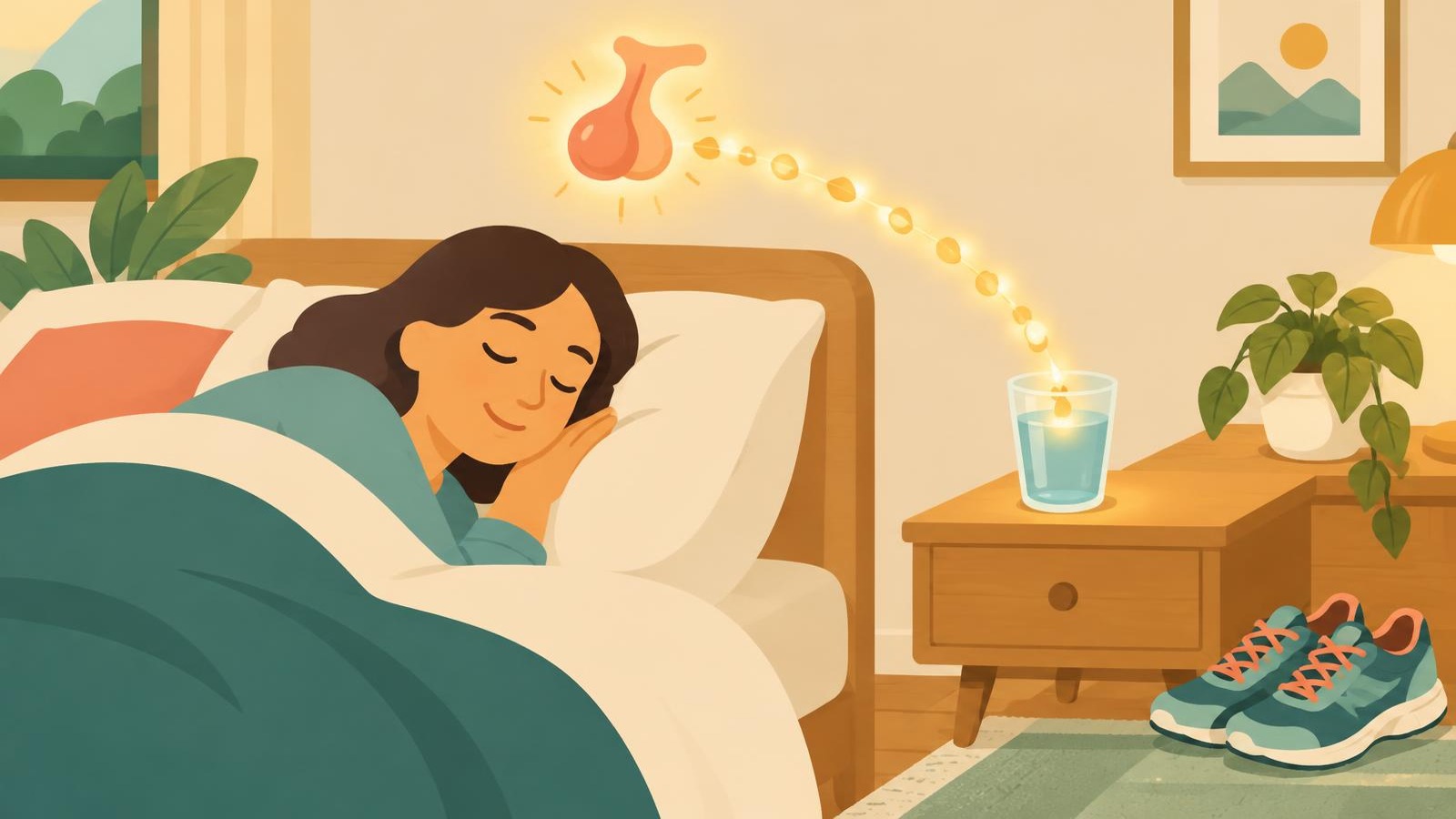
A growth hormone secretagogue is a compound that signals your pituitary gland to release your own growth hormone. It does not supply growth hormone from outside the body. Sermorelin, CJC-1295 and tesamorelin copy the growth hormone releasing hormone signal. Ipamorelin copies ghrelin. Only tesamorelin is an FDA-approved drug in the United States today, and only for one narrow condition. Most of what people read online about the others rests on animal studies and small early human work.
This article is for education only. It is not medical advice, and it does not recommend, prescribe or advertise any product.
What is a growth hormone secretagogue?
Your pituitary gland releases growth hormone in pulses. The biggest pulses come during deep sleep. Growth hormone then tells your liver and other tissues to make IGF-1, which is the number your clinician can measure in a blood test.
Two natural signals control the pulses. Growth hormone releasing hormone (GHRH) comes from the hypothalamus and tells the pituitary to release. Ghrelin, the hormone best known for hunger, also tells the pituitary to release, through a different receptor. A secretagogue is any compound that pushes one of those two switches.
Researchers got interested for a simple reason. Growth hormone output falls with age, and that drop lines up with changes many midlife adults notice, like less lean mass, more belly fat and slower recovery. Lining up with a change is not the same as causing it. Scientists still argue about how much of that decline matters and whether replacing it helps healthy adults.
How do sermorelin, CJC-1295, ipamorelin and tesamorelin differ?
They split into two families.
The GHRH family includes sermorelin, CJC-1295 and tesamorelin. Each is a lab-made version of the hypothalamic signal, tweaked to last longer in the body. Sermorelin is the shortest, a fragment of natural GHRH. Tesamorelin is a longer GHRH analog. CJC-1295 is a modified GHRH analog built to resist breakdown.
The ghrelin-mimetic family includes ipamorelin. It binds the ghrelin receptor on the pituitary and triggers a growth hormone release.
Here is the part that matters for safety and for science. A GHRH analog works through the body's normal pulse system, so the pituitary still has a say. A ghrelin mimetic works on a separate pathway, and older compounds in that family also raised stress hormones. That is why researchers cared so much about selectivity.
What do the animal studies show?
The best-known preclinical paper is the 1998 study that introduced ipamorelin, published in the European Journal of Endocrinology by Raun and colleagues at Novo Nordisk. The team tested it in rat pituitary cells, anesthetized rats and conscious pigs, and compared it against older compounds called GHRP-6 and GHRP-2.
The main findings, as reported in the abstract:
In rat pituitary cells, ipamorelin released growth hormone with an EC50 of 1.3 nmol/l, compared with 2.2 nmol/l for GHRP-6. In anesthetized rats, its ED50 was 80 nmol/kg. In conscious pigs, its ED50 was 2.3 nmol/kg. In pigs, none of the compounds changed FSH, LH, prolactin or TSH. GHRP-6 and GHRP-2 raised ACTH and cortisol. Ipamorelin did not, even at doses more than 200 times its growth hormone ED50.
The authors concluded that ipamorelin was the first compound in its class with growth hormone selectivity similar to GHRH itself.
That is a clean result. It also has hard limits. Rats and pigs are not people. The doses were measured per kilogram in lab animals under controlled conditions. The authors worked for the company that made the compound. And the study tested release of growth hormone and other hormones in the short term. It did not test whether any of that changes body composition, strength, sleep or long-term health in a middle-aged adult.
Why do animal results not translate cleanly to people?
Four reasons come up again and again.
First, species differ in receptor biology and in how fast the body clears a peptide. A dose that works in a pig may do something else in a person.
Second, lab animals are young, healthy and housed in controlled settings. Your life is none of those things.
Third, a hormone number moving is not a health outcome improving. Raising growth hormone and IGF-1 can raise risk too. Higher IGF-1 has been linked in some research to cancer risk, and growth hormone can change blood sugar. That is one reason regulators ask for long human trials.
Fourth, peptides made at scale can carry impurities, and the body can form antibodies against them. Animal studies rarely answer that question well.
Read any claim built only on animal data as a reason to ask a better question, not as an answer.
What is FDA-approved and what is not?
Tesamorelin is sold as Egrifta. Its label says it is indicated for the reduction of excess abdominal fat in HIV-infected adult patients with lipodystrophy. The label states that it is not indicated for weight loss management and that long-term cardiovascular safety has not been established. It lists warnings for neoplasms, elevated IGF-1, fluid retention, glucose intolerance and hypersensitivity, and it is contraindicated in pregnancy, active malignancy and disrupted hypothalamic-pituitary function.
The two pivotal trials ran 26 weeks. In the first, visceral fat fell by 27 square centimeters on tesamorelin versus a 4 square centimeter rise on placebo. In the second, it fell by 21 versus no change. Those participants were adults with HIV and lipodystrophy, a different group from a healthy 48-year-old who wants to feel stronger.
Sermorelin was FDA-approved in 1997 for children with growth hormone deficiency and as a diagnostic agent. Its maker stopped production in 2008. According to a 2013 FDA determination cited on its reference page, the reason was business-related and not safety or effectiveness. For adults, conclusive benefit data are lacking.
CJC-1295 and ipamorelin are not FDA-approved drugs. FDA maintains a public page on bulk drug substances that raise safety concerns for compounding. That page lists CJC-1295 and ipamorelin, and it cites limited clinical data and immunogenicity risk. FDA classifications change, so check FDA's current list rather than trusting any blog, including this one.
What does this mean if you live in Dartmouth, New Bedford or Westport?
It means the loudest claims about these compounds run ahead of the evidence. If a gym, a social media page or a website promises that a peptide will melt fat or reverse aging, treat it as marketing until a clinician you trust shows you human trial data.
It also means the basics keep earning their place. Deep sleep is where your biggest natural growth hormone pulses happen. Lifting heavy things two or three days a week raises growth hormone for a short window and builds the muscle that protects you as you age. If you want to see where you stand, start with how to read your own bloodwork, then look at a minimum effective dose of resistance training that fits your week.
I build the program and coach the training. Our collaborating NP or MD prescribes and orders. Nothing in this article changes that line, and nothing here is a treatment recommendation.
What should you ask before considering any peptide?
Bring these questions to your own licensed prescriber.
Is this product FDA-approved for what I want it to do? If not, what is its regulatory status today?
What human trial data exist for someone like me, not for rats, pigs or a different patient group?
What would we measure before and after, and what result would make us stop?
Who makes it, and how is purity checked?
What happens to my IGF-1 and blood sugar, and what do we do if either moves the wrong way?
A good clinician welcomes these questions. A seller who dodges them has told you what you need to know.
Frequently asked questions
Does a secretagogue add growth hormone to the body?
No. It signals the pituitary to release its own. That is different from injecting growth hormone itself, which is a separate prescription drug with its own rules.
Is ipamorelin safer than older compounds?
In rats and pigs, it did not raise cortisol or ACTH the way GHRP-6 and GHRP-2 did. That is a lab finding in animals. It is not proof of safety in people, and FDA has flagged safety concerns about it in compounding.
Is tesamorelin approved for weight loss?
No. The label says it is not indicated for weight loss management. It is approved to reduce excess abdominal fat in adults with HIV and lipodystrophy.
Why was sermorelin pulled from the market?
Its maker discontinued it in 2008 for business reasons, and an FDA determination cited on its reference page says safety and effectiveness were not the cause.
Can a blood test tell me if my growth hormone is low?
Growth hormone comes in pulses, so a single draw is a poor snapshot. Clinicians often look at IGF-1 and the whole clinical picture. Interpretation needs a licensed clinician.
Where do other adjunct peptides fit?
They are a separate group, and each has its own evidence base and regulatory status. Future articles will cover them one at a time.
Sources
- Raun K, Hansen BS, Johansen NL, et al. Ipamorelin, the first selective growth hormone secretagogue. European Journal of Endocrinology. 1998;139(5):552-561.
Disclaimer
This article is for informational and educational purposes only. It is not medical advice and does not diagnose, treat or prevent any condition. It discusses research, much of it in animals, and does not recommend any product. Talk with a licensed healthcare provider before making any health decision.
Ready to talk through your sleep, training and labs?