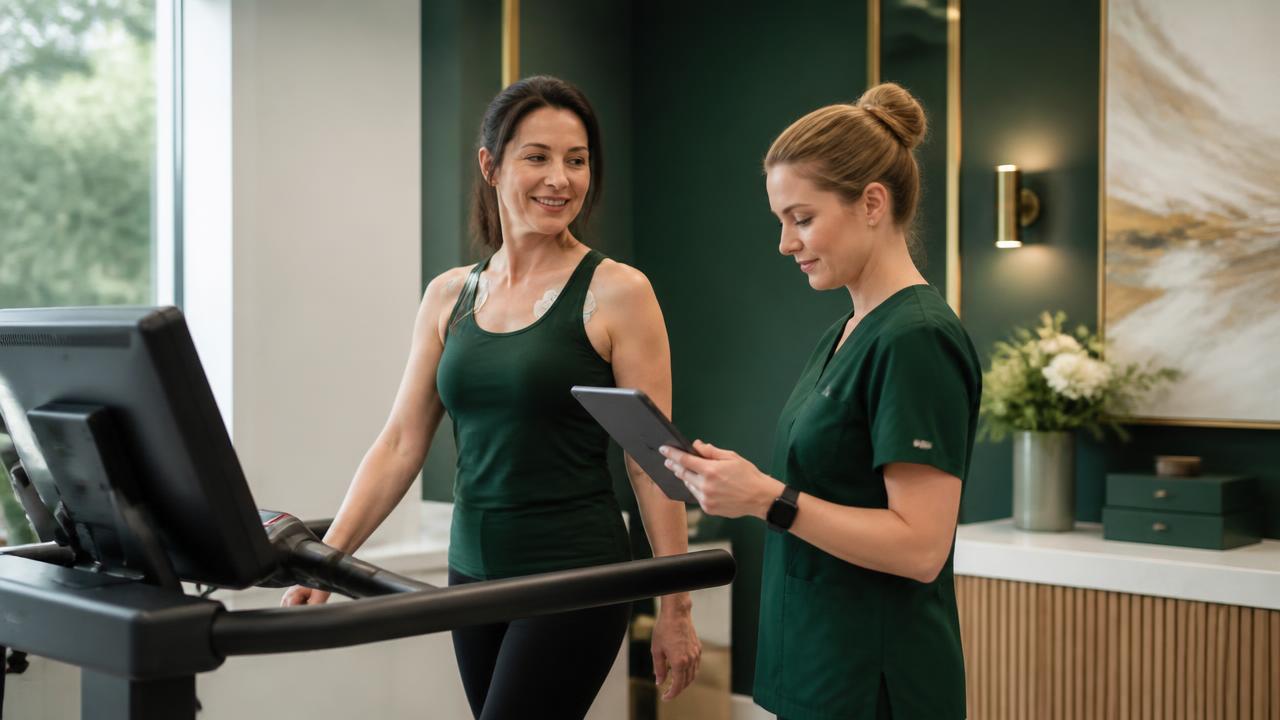
THE SHORT ANSWER: Cardio isn't a waste of time in perimenopause, but it's usually being asked to do the wrong job. Steady-state cardio is a weak tool for changing body composition on its own, which is why so many women add more of it and see the scale stay put. What cardio does build is cardiorespiratory fitness, often estimated as VO2 max, and that's one of the better-studied markers of long-term health in adults. A 2018 cohort of more than 122,000 adults undergoing treadmill testing found no upper limit to the mortality benefit of higher fitness. A 2026 systematic review of randomized trials in menopausal women found that physical activity of all types improved cardiorespiratory fitness. So the useful question isn't cardio versus lifting. It's what each one is for, what you're measuring, and whether anyone is actually tracking it.
Why does cardio stop working for weight loss in midlife?
It probably never worked the way it was sold. Aerobic exercise burns calories during the session, and the body is good at quietly clawing some of that back through reduced movement the rest of the day and increased appetite. That's true at 25 and at 50. What changes in perimenopause is the margin for error.
Through the menopause transition, several things shift at once. Lean mass tends to decline with age unless it's defended. Fat distribution tends to move toward the midsection. Sleep quality often deteriorates. Each of those affects how the body handles fuel, and none of them are fixed by adding a fourth spin class.
So women add cardio, the scale doesn't move, and the conclusion they draw is that their body is broken. The more accurate conclusion is that they picked a tool that was never going to move that particular number very far.
That's the part the internet gets right. Where the internet then overcorrects is by telling midlife women cardio is pointless. It isn't. It's just measuring something else.
What is VO2 max, and why do clinicians care about it?
VO2 max is the maximum rate at which your body can take in and use oxygen during hard exercise. Think of it as a ceiling on how much work your heart, lungs, blood, and muscle can do together. It's usually expressed in milliliters of oxygen per kilogram of body weight per minute.
The reason it shows up in cardiology literature and not only in sports science is that it behaves like a health marker, not a performance stat. In the 2018 JAMA Network Open analysis of 122,007 adults who underwent exercise treadmill testing at a major health system, higher cardiorespiratory fitness was associated with lower long-term all-cause mortality, and the researchers reported no observed ceiling to that association (Mandsager et al., JAMA Netw Open, 2018, PMID 30646252). That's an association in an observational cohort, not proof that raising your number causes you to live longer. It's still one of the more striking dose-response patterns in the literature.
It also has a practical virtue that a lot of wellness metrics lack. It's measurable, it's repeatable, and it responds to training within weeks. You can watch it move.
Does exercise actually improve cardiorespiratory fitness during menopause?
This is where the evidence gets specific to the population we work with.
A 2026 systematic review and meta-analysis of randomized controlled trials, published in the Journal of Science in Sport and Exercise, pooled trials of physical activity in menopausal women and looked at cardiorespiratory fitness and cardiovascular risk markers. Across intervention types, physical activity showed favorable effects on cardiorespiratory fitness, with possible associated reductions in systolic blood pressure. The authors were candid about the limits: there was unexplained heterogeneity between trials and unclear risk of bias from incomplete reporting, and they called for future trials to look harder at age and exercise intensity as moderators (Woodward et al., J Sci Sport Exerc, 2026).
Read that carefully, because the honest version is more useful than the hyped one. The finding is not "cardio reverses menopause." The finding is that training improves a meaningful fitness marker in this population, across formats, and the certainty of the effect size is moderate at best.
There's a parallel body of cross-sectional work looking at cardiorespiratory fitness alongside cardiovascular risk factors and quality of life in perimenopausal and postmenopausal women (PubMed), and work in Menopause examining how fitness and body composition sit between physical activity and menopausal symptoms (Menopause, 2024). Cross-sectional data can't establish direction. Fitter women may feel better, or women who feel better may train more. Both stories fit the same data.
So how much cardio, and what kind?
The federal Physical Activity Guidelines for Americans set the floor for adults at 150 to 300 minutes of moderate-intensity aerobic activity per week, or 75 to 150 minutes of vigorous activity, plus muscle-strengthening work on 2 or more days per week. That's a public health floor, not a personalized prescription, and it's worth noticing that the strength component is not optional in the guideline. It gets dropped from the conversation constantly.
In practice, the structure I coach most often for midlife clients looks like this, and it's a starting framework rather than a rule:
Most aerobic minutes go in at an easy, conversational effort. You should be able to talk in full sentences. This is the volume that builds the aerobic base without adding fatigue that wrecks your lifting or your sleep.
A small amount of harder work gets layered on once the base is there. Short, hard intervals with full recovery are what tend to move a VO2 max number, and they're also the part most people either skip entirely or do every single session at a miserable middle intensity that's too hard to recover from and too easy to drive adaptation.
Strength training stays the anchor. Cardio is additive. It doesn't replace resistance training for protecting lean mass, and any program that quietly swaps one for the other is working against you.
If you're coming off a long layoff, carrying an old injury, or managing a cardiovascular condition, the right starting point is a conversation with your physician or our collaborating provider before you add intensity. That's not boilerplate. Intensity is the variable that carries risk.
What should you measure instead of the scale?
The scale is a single number that blends muscle, fat, water, and what you ate yesterday. It's the least informative number most people track daily.
Things that tend to be more useful over a 12-week window:
A fitness marker, whether that's an estimated VO2 max from a wearable, a timed walk or run benchmark, or heart rate recovery after a hard effort. Consumer estimates aren't lab-grade, but they're directionally useful if you keep the protocol the same each time.
A strength number. Something you can load and repeat.
Body composition rather than body weight, if you have access to a consistent method.
Lab biomarkers, ordered and interpreted under a provider. At our clinic, that's where fasting insulin, a lipid panel that goes beyond the basics, thyroid markers, and inflammatory markers come in. We also use genomic testing to add context about how an individual tends to respond to different training and nutrition inputs. None of these diagnose anything on their own, and none of them are a substitute for your primary care.
How you feel at 3pm. Not a metric anyone can chart, and still the thing most women actually came in for.
What does this look like in Dartmouth and across the SouthCoast?
Most of the women we see in Dartmouth, New Bedford, Westport, Fairhaven, and Fall River aren't short on effort. They've been walking, doing classes, and in a lot of cases doing more cardio than they were 10 years ago. What they haven't had is anyone reading the actual data and telling them what each piece of their week is supposed to accomplish.
That's the gap. Volume-based telehealth isn't going to close it, because nobody there is going to know your name in month 4, let alone watch a fitness marker trend across a season. In-person care in Dartmouth, MA means the person building your program is the same person coaching the training and sitting with you when the lab results come back.
Our programs pair coaching with lab and genomic testing, and the Genomic Menopause Reset is built specifically for the midlife metabolic picture. Prescriptions and lab orders are written by our collaborating NP or MD. I build the program and coach the training. Where medication is part of a plan, it's medically supervised weight loss medication, provider-prescribed, with monitoring and follow-up built in rather than bolted on. Some peptide and medication uses in functional wellness are off-label or investigational at the category level, and that status gets stated plainly in your consult before anything is decided.
Frequently asked questions
Will walking count?
Yes, for aerobic base. Whether it's enough to move a VO2 max number depends on your starting point and how hard the walking is. For someone deconditioned, brisk walking can move it. For a trained person, it generally won't.
Do I need a lab VO2 max test?
Not to get started. A consistent submaximal benchmark you repeat every 8 to 12 weeks tells you most of what you need about direction. Formal testing is a different conversation and a medical one.
If cardio doesn't drive fat loss, why do it at all?
Because fat loss isn't the only outcome worth having. Cardiorespiratory fitness tracks with long-term health outcomes in large cohorts, and it's trainable at every age studied.
Can I do this while on weight loss medication?
Training is part of a properly supervised plan, not a separate project. The specifics belong in a conversation with the prescribing provider, since intensity, hydration, and nutrition timing all interact with the medication.
Ready to find out what your numbers are doing?
If you've been adding cardio and getting nothing back, the problem may be that nobody has told you what you're measuring. Book a free discovery call and we'll talk through what testing would actually tell you, what a program would look like, and whether we're the right fit. It's a conversation, not a pitch. We see patients in person in Dartmouth, MA.
You can read more of our education articles here.
This article is educational and is not medical advice, diagnosis, or treatment. It doesn't establish a clinician-patient relationship. Individual results vary, and nothing here is a promise of any particular outcome. Vitality Dartmouth is an RN-led clinic; all prescriptions and lab orders are written by a collaborating nurse practitioner or physician. Talk with your own physician before starting or changing an exercise program, a supplement, or a medication, particularly if you have a cardiovascular, metabolic, or musculoskeletal condition.