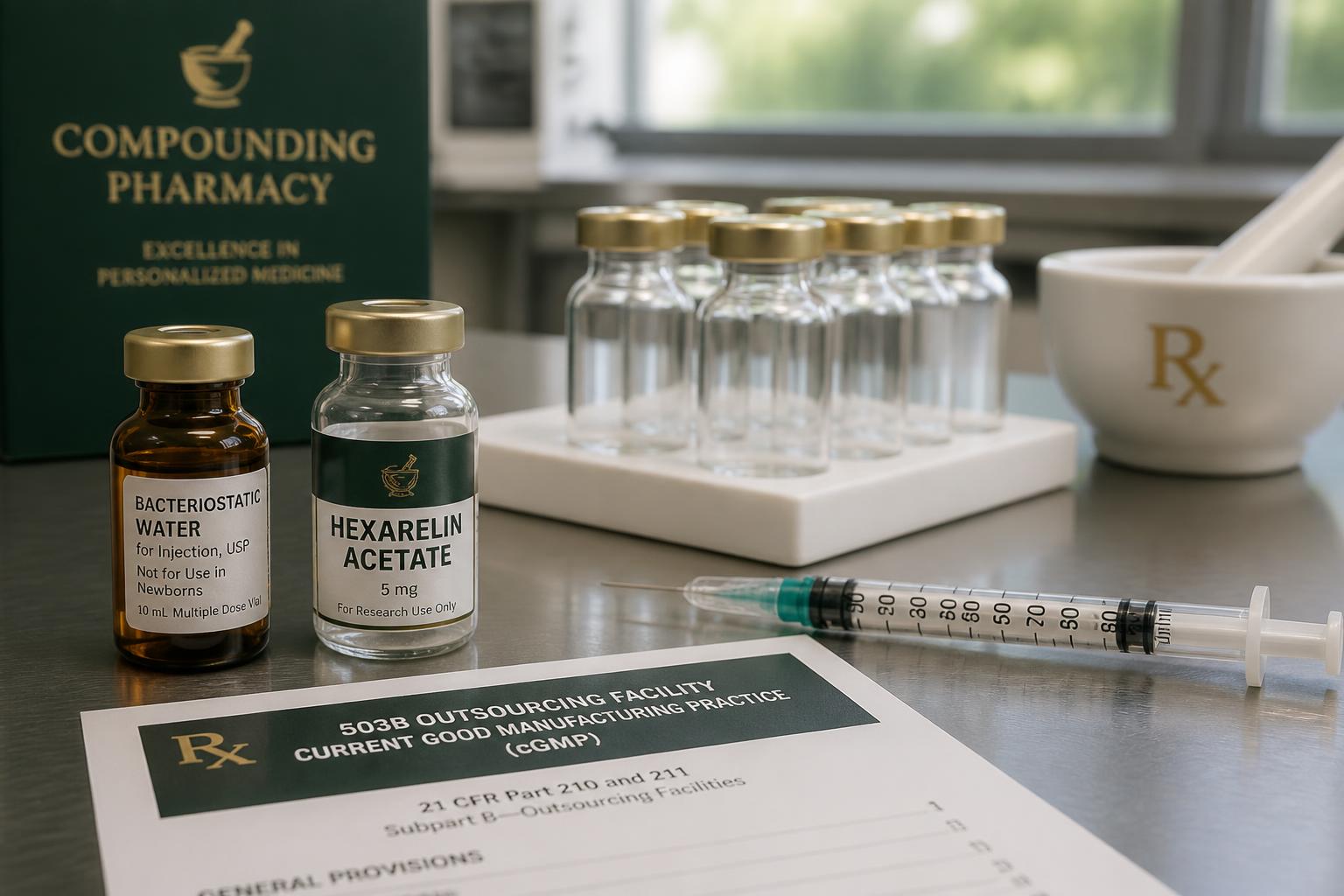
If you've used BPC-157 for recovery in the past, you probably noticed it became harder to get through a legitimate pharmacy starting in early 2025 — that's because the FDA placed it on a prohibited list for compounding, following a 2023 determination that the agency felt there wasn't yet sufficient clinical safety evidence. That made headlines again on July 23-24, 2026, when the FDA's Pharmacy Compounding Advisory Committee (PCAC) met and voted to recommend BPC-157 be added back to the approved 503A Bulks List — one of six peptides (of seven reviewed) the committee backed, alongside KPV, TB-500, MOTS-c, Semax, and Epitalon. The BPC-157 vote itself was close, 8-6 with one abstention. Here's the honest, no-hype version of what that does and doesn't mean, because the details matter a lot more than the headline.
In early 2025, the FDA banned BPC-157 from legal pharmacy compounding, citing insufficient clinical safety data — pushing much of the market to unregulated online sellers with no purity or sterility testing. On July 23-24, 2026, an FDA advisory committee voted 8-6 (with one abstention) to recommend reversing that and adding BPC-157 back to the approved compounding list, one of six peptides it backed out of seven reviewed. Notably, the committee overrode FDA career scientists who had recommended against all seven substances. This is a meaningful signal, but it is only a recommendation — not an approval, and not a green light. The FDA and HHS still have to act on it, human clinical trial data is still limited, and nothing about how BPC-157 should be sourced or monitored has changed yet. If you're considering peptide therapy, this is a good moment to understand where things actually stand.
What did the FDA committee actually vote on?
The Pharmacy Compounding Advisory Committee is an FDA advisory body that reviews substances for the 503A Bulks List — the list of bulk drug substances that licensed compounding pharmacies are legally allowed to use to prepare individualized prescriptions. Over two days in July 2026, the committee reviewed seven peptide-related substances — BPC-157, KPV, TB-500, MOTS-c, Semax, Epitalon, and emideltide — and recommended six of them, including BPC-157, for inclusion on that list. Only emideltide was voted down (7-6, with one abstention). The BPC-157 vote passed 8-6 with one abstention — a genuinely split committee, not a unanimous green light.
That recommendation matters because it's the clearest signal in over a year that the regulatory environment for these peptides may be loosening — and it's notable that the committee went further than FDA's own career scientists, who had reportedly recommended against all seven substances under review. But "recommended by an advisory committee" and "approved by the FDA" are two very different things. Advisory committee votes are non-binding — the FDA and HHS are not required to follow them, and even when they do, formal listing takes additional time (FDA meeting materials). As one industry summary put it plainly: a vote here does not make a peptide FDA-approved, clinically proven, or immediately available.
Why was BPC-157 restricted in the first place?
BPC-157 (Body Protection Compound-157) is a synthetic peptide studied mostly in animal models for tissue repair, gut healing, and tendon/ligament recovery. In 2023, the FDA determined it lacked sufficient safety evidence and clinical usefulness data to remain available through compounding pharmacies, and in early 2025 it was formally prohibited from that channel.
The core issue was never that BPC-157 was proven dangerous — it's that human clinical trial data has been thin. Animal and preclinical research has looked promising for years, but the FDA's bar for compounded substances requires more than promising preclinical signals.
What happens now, practically?
For now, essentially nothing has changed in terms of legal availability. The committee's recommendation goes back to the FDA and HHS, which will decide whether and how to formally act on it. Until that happens:
- BPC-157 remains off the 503A Bulks List, meaning licensed compounding pharmacies still cannot legally prepare it.
- The unregulated market hasn't gone anywhere. Products sold online outside licensed pharmacy channels continue to exist with no mandatory third-party testing for purity, potency, or sterility — this has been the primary safety concern throughout the restriction period, and it doesn't disappear because of a committee vote.
- Human trial data is still the real bottleneck. Even if BPC-157 returns to the compounding list, that doesn't retroactively create the large-scale human clinical trials needed for full FDA drug approval — compounding availability and formal drug approval are different regulatory tracks entirely.
What this means if you're considering peptide therapy
I'll be straightforward about how I think about this in clinic. A friendlier regulatory signal is good news for the field generally — it suggests a majority of the advisory committee sees enough here to take a second look, even over the objections of FDA's own scientists. But it doesn't change the fundamentals of what responsible peptide use requires:
- Sourcing has to be legitimate, whatever the current regulatory status — never a product without verifiable pharmacy-grade sourcing and testing.
- Clinical oversight matters more, not less, during a period of regulatory flux. When rules are actively changing, and even the experts are split, that's exactly when you want a provider tracking the actual FDA status, not marketing claims.
- "Promising" is not the same as "proven." Preclinical and animal data on BPC-157 for tissue and gut repair is genuinely interesting, but it should be discussed with appropriately hedged expectations, not sold as a guaranteed fix.
How we handle this at Vitality Dartmouth
Peptide protocols are one of our core service lines, and regulatory status is something we track directly rather than leaving clients to sort out on their own. In practice:
- We follow official FDA status, not headlines or marketing, when advising on any peptide's availability and appropriateness.
- Everything is individualized and screened. Labs and history first, through the same process we use for our genomic testing and lab work, before any peptide or medication conversation.
- We're upfront when something is investigational or restricted. The same way we disclose that retatrutide is an investigational GLP-1/GIP/glucagon agent not yet FDA-approved when clients ask about it, we'll tell you plainly where BPC-157 and similar peptides currently stand — not oversell a close committee vote as a green light.
- Recovery protocols are built around your full picture — nutrition, training load, and sleep through our coaching programs, not a peptide in isolation.
Frequently asked questions
Is BPC-157 legal now?
Not yet, as of this writing. The FDA advisory committee voted 8-6 (with one abstention) to recommend BPC-157 be added back to the approved compounding list on July 23-24, 2026, but that recommendation is non-binding, and the FDA/HHS have not yet formally acted on it. Status can change — this is worth confirming directly with a provider rather than relying on older information.
Does this mean BPC-157 is proven safe and effective?
No. The committee recommendation is about compounding-list eligibility, not clinical proof — and even the committee itself was split, overriding FDA career scientists who had recommended against it. Human clinical trial data remains limited, which is the main reason full FDA approval hasn't happened.
Should I buy BPC-157 online while I wait for the rules to settle?
That's exactly the risk to avoid. Products sold outside licensed pharmacy channels aren't subject to mandatory purity, potency, or sterility testing. If and when BPC-157 returns to legal compounding, working through a licensed pharmacy and a provider who verifies current status is the safer path — regardless of how the regulatory picture evolves.
Do you offer peptide therapy near me?
Yes — Vitality Dartmouth is based in Dartmouth, MA and works with clients across the SouthCoast, including New Bedford, Westport, Fairhaven, and Fall River, with RN-supervised protocols built around your labs and history.
The bottom line
The FDA advisory committee's July 2026 recommendation to add BPC-157 back to the approved compounding list is a real, worth-watching development — but it was a close, split vote, it's a recommendation rather than a rule change, and it doesn't resolve the underlying question of clinical proof. If you're interested in peptide therapy, the right move isn't to chase headlines or unregulated online sellers; it's to work with a provider who's actually tracking the FDA process and can tell you honestly where things stand today.
This article is for educational purposes only and is not medical advice. It describes the current status of an FDA regulatory process, which is subject to change; nothing here should be read as confirmation that BPC-157 is currently legal for compounding or FDA-approved. Peptide therapies are individualized clinical decisions with risks and contraindications. Discuss any treatment decision with a licensed healthcare provider. Individual results vary.