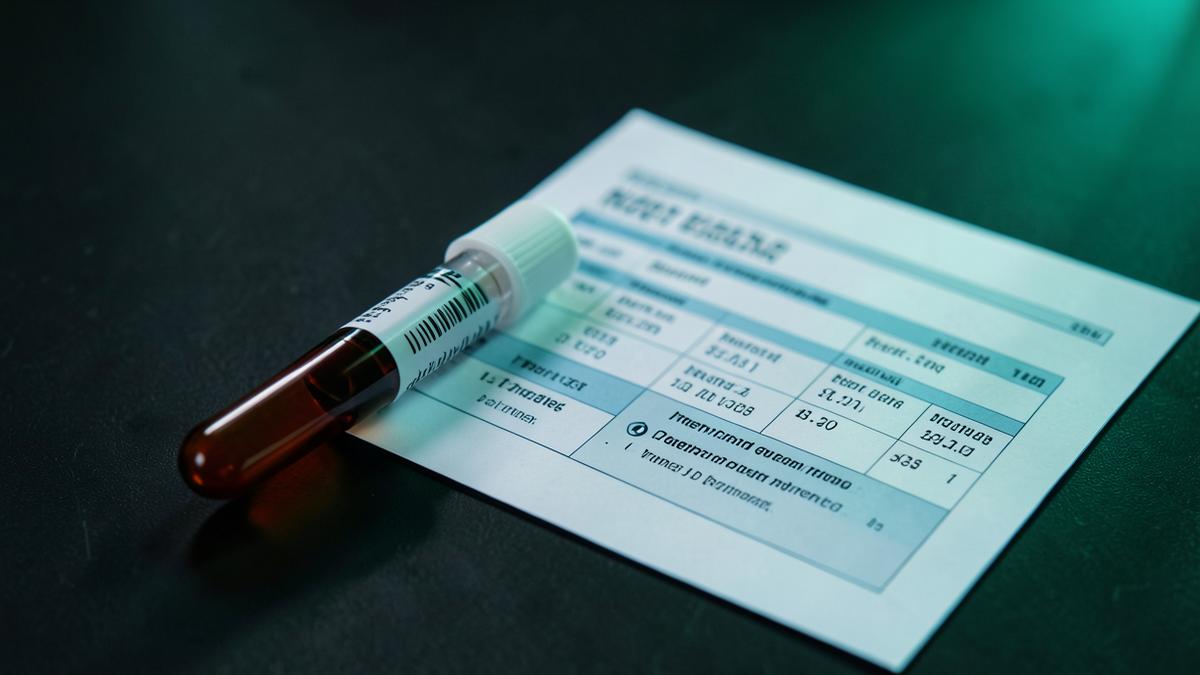
Ferritin is the blood test that estimates how much iron your body has in storage, and it's a different question from the one a standard CBC answers. A CBC checks whether you have enough iron circulating right now to build red blood cells. Ferritin checks whether the reserve tank behind that is full or running on fumes. Those two numbers can disagree, and when they do, the storage number usually falls first. That's the gap where a lot of women get told their bloodwork looks fine while they still feel exhausted, cold, and flat in the gym. Iron deficiency without anemia is a recognized clinical entity, and it's plausible in menstruating and perimenopausal women in particular, because monthly blood loss is an ongoing iron drain. Whether it applies to any individual is a question for lab data and a licensed provider, not for a symptom checklist. But it's a question worth asking out loud, because nobody finds a number they never ordered.
What does ferritin actually measure?
Ferritin is a storage protein. Your body packs iron inside it in the liver, spleen, and bone marrow, and a small amount leaks into the bloodstream in rough proportion to how much you have stored. That's why serum ferritin is used as an indirect estimate of total body iron stores. The NIH Office of Dietary Supplements iron fact sheet walks through the biology in detail and is a good primary reference if you want the technical version.
Here's the part that matters for how you read your own results. Iron depletion happens in stages. Stores drop first, which shows up as falling ferritin. Then iron available for red blood cell production tightens, which shows up as a rising transferrin and a falling transferrin saturation. Only at the end does hemoglobin drop far enough to be called anemia. A CBC alone catches the last stage. Ferritin can catch the first.
Why can hemoglobin be normal when iron stores are low?
Because your body protects red blood cell production before it protects anything else. Oxygen delivery is the priority, so the marrow keeps pulling from storage to keep hemoglobin in range. You can spend a long time in that borderline zone, drawing down reserves, while every number on a basic panel still prints inside the reference range.
The clinical review of iron deficiency in the New England Journal of Medicine lays out this staged depletion clearly, and the NHLBI overview of iron deficiency anemia covers the causes and workup. Neither says that low stores are automatically the explanation for anyone's fatigue. Both make it clear that a normal hemoglobin doesn't rule low stores out.
This is the whole reason I keep saying that "normal" and "optimal" are not the same word. A reference range is a statistical description of the population that got tested at that lab. It isn't a target, and it wasn't built around how you want to feel on a Tuesday afternoon.
What ferritin level counts as low in women?
This is where reasonable clinicians still disagree, so I'm going to give you the honest version instead of a clean one.
Many US labs set the bottom of the female ferritin reference range somewhere in the 10 to 15 ng/mL neighborhood. A body of research over the last decade has argued that threshold is too permissive, and that a cutoff closer to 25 to 30 ng/mL better identifies people whose iron stores are genuinely depleted. Some clinicians go further and use a higher symptomatic threshold when someone has ongoing fatigue, hair shedding, or restless legs and no other explanation. You can read the published debate yourself through a PubMed search on ferritin thresholds for iron deficiency.
What I'd take from that as a patient is not a magic number. It's this: if your ferritin came back at 14 and someone told you it was normal, that's technically true against that lab's range and it may still be worth a conversation with a provider. A number sitting one point above a cutoff isn't a clean bill of health. It's a data point that deserves context, symptoms, and a repeat measurement over time.
Why does perimenopause make iron loss worse, not better?
There's a common assumption that iron stops being an issue as you approach menopause. The pattern often runs the other way first.
Perimenopause is not a gentle slide to zero. Cycles frequently get irregular and heavier before they stop, and heavy menstrual bleeding is one of the most common drivers of iron loss in adult women. So a woman can be losing more iron per month at 47 than she was at 37, at the same time that she's eating less, sleeping worse, and blaming all of it on age. Then the cycles stop, monthly losses end, and ferritin generally starts climbing again over the following years.
That's two different iron pictures in the same decade, which is exactly why a single lab draw at one moment tells you less than a trend does. It's also why our Genomic Menopause Reset is built around repeat measurement rather than a one-time snapshot. Menopause gets treated as something to endure. It's a metabolic transition, and a lot of it is measurable.
What symptoms tend to show up before anemia does?
I want to be careful here, because none of these are diagnostic and every one of them has a long list of other possible causes. Fatigue is the least specific symptom in medicine. But the symptoms clinicians commonly associate with low iron stores, described in the references above, include:
Persistent fatigue that rest doesn't fix. Reduced exercise capacity, especially a heart rate that runs higher than usual for the same work. Hair shedding. Feeling cold when nobody else in the room does. Restless legs at night. Brain fog. Shortness of breath on stairs you used to take without thinking.
If several of those are true for you and nobody has ever checked your iron stores, that's not a diagnosis. It's a reason to ask a licensed provider whether the test is appropriate for your situation.
Can inflammation make a ferritin result look falsely reassuring?
Yes, and this is the single most important caveat on the whole test.
Ferritin is an acute-phase reactant. It rises with inflammation, infection, liver disease, and some chronic conditions, independent of how much iron you actually have stored. That means someone with real iron depletion plus an inflammatory process can produce a ferritin that lands in the middle of the range and looks fine. Reading ferritin in isolation is how that gets missed.
The practical answer is to never read it alone. A useful iron picture generally pairs ferritin with a CBC, a full iron panel including transferrin saturation, and an inflammatory marker such as CRP, so the numbers can be interpreted against each other. Which tests are appropriate, and what they mean for you, is a provider's call.
Does genomic testing add anything to an iron workup?
Sometimes, and mostly on the other end of the range.
Hereditary hemochromatosis, the most common inherited cause of iron overload in people of Northern European descent, is associated with variants in the HFE gene. Genomic testing can flag that predisposition, which is useful context in a family where somebody has been told their iron or ferritin runs high. Carrying a variant is not the same as having the condition, and confirming or excluding it involves iron studies, clinical evaluation, and a physician. Genomics is context, not a verdict.
That's how we treat DNA results generally in our genomic and lab biomarker testing work. The genome tells you about tendencies. The bloodwork tells you what's happening now. You need both to make a sensible plan, and you need a provider to order and interpret them.
How does medically supervised weight loss interact with iron?
Worth thinking about, and it's a conversation I want people having before it becomes a problem rather than after.
Medically supervised weight loss medication works substantially by reducing appetite and food intake. When total intake falls, intake of everything in the food falls with it, including iron, protein, and B12. Red meat is one of the most bioavailable dietary iron sources, and it's also one of the first foods people report going off when appetite drops. Add restricted intake to ongoing menstrual losses and you have two pressures pointing the same direction.
None of that is an argument against the medication. It's an argument for the monitoring around it. Our medically supervised weight loss program runs with lab follow-up, protein targets, and resistance training built in, precisely because a script with no nutrition plan and no bloodwork is how people lose muscle alongside fat. Every prescription in the program is written by our collaborating NP or MD. I build the program and coach the training. I don't prescribe or diagnose, and I don't order labs.
Is more iron always the answer?
No, and please don't run out and buy a supplement on the strength of a blog post. Mine included.
Iron is one of the nutrients where more is not automatically better. Excess iron accumulates, the body has no efficient way to excrete it, and unsupervised supplementation in someone who doesn't need it carries real risk. High-dose iron products are also a leading cause of accidental poisoning in young children, which is why the FDA's dietary supplement guidance exists and why storage matters if there are kids in the house.
There's also a dosing wrinkle worth knowing about, and it's a live scientific argument rather than settled fact. Two randomized trials by Stoffel and colleagues, published in Lancet Haematology in 2017, found that oral iron given on alternate days produced better fractional absorption than consecutive daily dosing in iron-depleted women. The proposed mechanism is hepcidin, a hormone that rises after an iron dose and blunts absorption of the next one for roughly the following 24 hours.
That work shifted a lot of clinical practice. It hasn't ended the debate. Later trials have reported mixed results on whether the absorption advantage translates into faster correction of hemoglobin and ferritin, and at least one has favored daily dosing on those endpoints. So the honest summary is that absorption efficiency and clinical outcome are two different questions, and the second one is still being worked out. Which is the point: the way someone takes iron can matter as much as whether they take it, and that's a conversation for a provider who can weigh the current evidence against your actual numbers, not something to settle from a bottle off a shelf.
Iron testing in Dartmouth and the SouthCoast
We see patients in person in Dartmouth, MA, and most of the people who come through are from Dartmouth, New Bedford, Westport, Fairhaven, and Fall River. The pattern I hear about most often on a discovery call is some version of the same sentence: "My doctor said my bloodwork was normal, and I still feel like this."
Sometimes the answer really is that the labs are fine and the problem is somewhere else, and I'll say that plainly when that's what the data shows. What I won't do is stop at a CBC and call it a workup. If low iron stores are on the list of things worth ruling in or out, that means an iron panel, a ferritin, an inflammatory marker to interpret it against, and a repeat draw down the road to see which direction the trend is moving. Our collaborating provider orders the panel. We sit down together and go through what the numbers say, in person, at a table, not as a PDF in your inbox with a supplement upsell attached.
That's the difference between a lab result and a lab review. Volume telehealth is optimized for throughput. Nobody there is going to remember your name in month 4, and nobody there is going to notice that your ferritin went from 38 to 21 across two draws.
Book a discovery call
If you're in Dartmouth, New Bedford, Westport, Fairhaven, Fall River, or anywhere on the SouthCoast, and you've been told your bloodwork is normal while you still feel wrecked by 2 p.m., book a free discovery call. It's a conversation, not a sales pitch, and it's where we figure out whether testing makes sense for your situation.
Educational disclaimer. This article is general health education and is not medical advice, a diagnosis, or a treatment recommendation. It does not establish a patient relationship, and no individual result or outcome is implied or guaranteed. Justin Coelho is a registered nurse and does not prescribe, diagnose, or independently order diagnostic testing. All prescriptions and lab orders at Vitality Dartmouth are written by a collaborating nurse practitioner or physician. Do not start, stop, or change any supplement or medication, iron included, without talking to your own licensed healthcare provider. If you have symptoms that concern you, contact your provider. For emergency symptoms, call 911.